
TAO CHRONICLES
Episode Two: The Building Without A Name

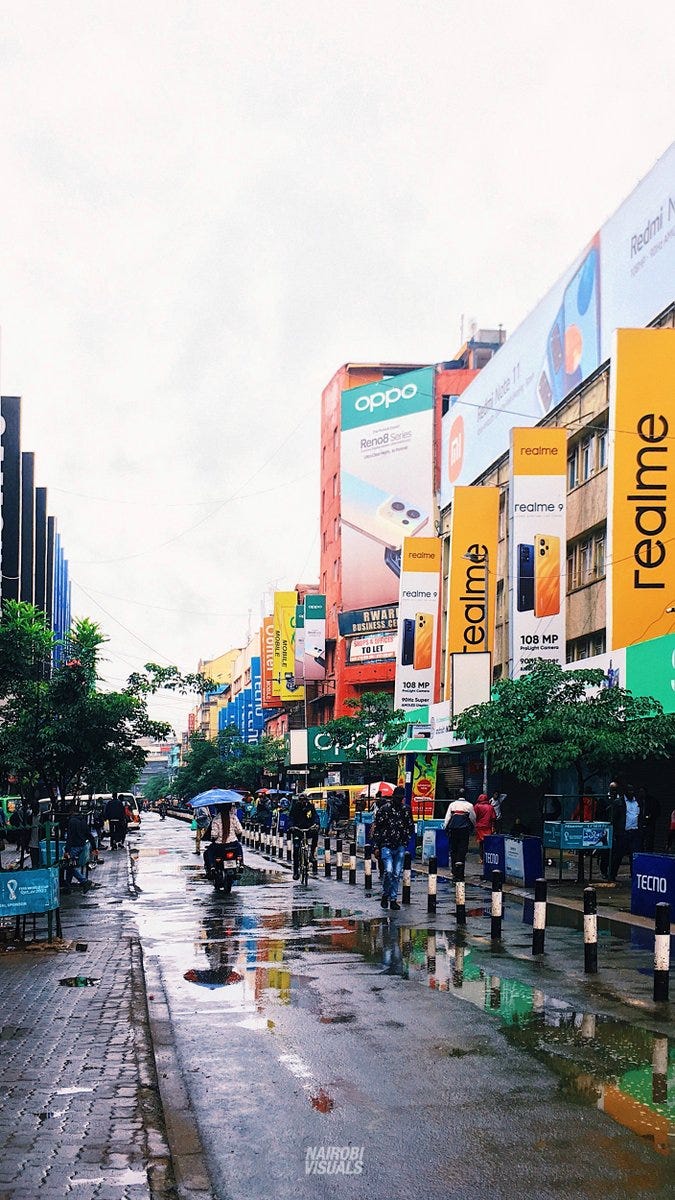
Tony sat down because his legs had filed for early retirement.
The stool underneath him wobbled in that specific River Road way, a wobble that suggests the stool itself has seen things and is no longer interested in standing firm for anybody. He held the photograph with both hands like it was a hot mandazi he could not yet figure out how to eat.
Three weeks ago.
Three weeks ago he had been in his bedroom in Kahawa Sukari, eating supper off a plate balanced on his thigh, watching a YouTube video about a Kenyan guy who had moved to Qatar and become rich. Three weeks ago his mother had been on the sofa pretending the rice was not too salty. Three weeks ago his father had been, according to the Central Police Station, “still missing, inquiries ongoing,” which is government language for “we have forgotten.”
Three weeks ago his father had also, apparently, been standing in the sun holding a brown paper bag.
“Hii picha ilichukuliwa wapi?”
The girl did not look up from her book. “Eldoret.”
“Eldoret?”
“Town. Near Zion Mall. He had just bought groundnuts.”
Tony stared at her. The girl stared back. Eugene, who had been leaning on the door frame the entire time chewing what looked aggressively like miraa, finally spoke.
“Boss. Pumua.”
“Don’t tell me to breathe.”
“Sawa. Usipumue. Iko sawa pia.”
The girl finally closed her book. She slid it under the counter the way a soldier sheaths a weapon, with the slightly sad finality of someone who knows playtime is over.
“Antony,” she said. “I need you to listen and I need you to not interrupt me with anything dramatic. Hapana kupiga kelele. Hapana kulia. Hapana kuuliza maswali za sinema. Just listen.”
“Sawa.”
“Your father was not lost.”
“Sawa.”
“Your father lost himself.”
Tony’s mouth opened. The girl held up one finger. The mouth closed.
“There is a difference,” she continued, “between a man who disappears because something happened to him, and a man who disappears because something was going to happen to him. Your father was the second kind.”
She tapped the photograph.
“This was taken by a friend of his. A friend who has been keeping an eye on him for almost two years. Quietly. From a distance. Because that is what your father asked for.”
Tony’s voice came out smaller than he had planned. “Why?”
“Because of what is in this room.”
Tony looked around. Glass cases. Phones. Speakers. A small fan rotating on the wall like it was personally judging him. One of the three guys on stools was now eating sukuma wiki out of a small black paper bag. Nothing in the room looked like the kind of thing a man would abandon his family for.
The girl saw his face.
“Not the phones, Antony. Hizi phones ni za kuficha white. This shop is a front.”
“A front for what?”
She did not answer. Instead, she walked to the back wall, the one with the dirty calendar from 2019 hanging on it, the calendar with a photograph of Mount Kenya and the smiling face of an insurance company that no longer existed. She lifted the calendar.
Behind it was a door. Small. Steel. The kind of door that does not exist in normal buildings on normal streets in normal cities.
She opened it.
“Kuja uone.”
Tony stood up. His legs, which had earlier filed for retirement, were now filing a fresh complaint with HR. He walked over. He looked through the doorway.
Behind the door was not another room.
Behind the door was a staircase. Going down. A staircase that should not have existed, because they were on the third floor of a building, and the staircase was not going down to the second floor. It was going down into something else entirely. Into a corridor lit by long fluorescent tubes that hummed the specific hum of a place that has been quietly powered for a very long time. The corridor went on for what looked like the length of half of River Road.
Tony, who had grown up in this city, who had walked past this exact building maybe forty times, who had once eaten a samosa directly outside this exact building, said the only thing his brain could produce.
“Kwani hii basement ilikuja na mosiria? Juu hakuna basement River Road.”
“Wewe Antony, si ulisoma Sociology? Mambo ya geography unatoa wapi?”
“Before niende suspension Form Two niliifanya.”
“Mhmm. Hata hii building ilifanya geography. Na hii ni mambo mpya kwake.”
Tony looked at her properly for the first time. Really looked. Not at her face, which was pretty in an unbothered way, but at her hands. Her hands were rough at the knuckles. Old scars. Faint smudges of something dark under the nails that no amount of soap had ever fully removed. The hands of somebody who had been doing something physical for many years. He was twenty three. She looked maybe twenty seven.
“Wewe ni nani?”
She smiled, just a little, for the first time since he had walked in.
“My name is Wanjiku. Your father has been talking about you since you were nine years old. He used to say, ‘Huyu kijana wangu anakuanga smart sana, ni venye lazima aoshwe ndo akuwe mjanja.’”
She gestured at the corridor.
“Welcome to where I work. Welcome to where he worked. Welcome to the reason your family has eaten well for twenty years.”
Tony’s mouth was dry.
“What did my dad do?”
Wanjiku stepped into the doorway. The fluorescent tubes lit one side of her face and shadowed the other. From somewhere deep down the corridor, far away, Tony could hear a sound he could not place. It was not machinery. It was not voices.
It was a printing press.
A very, very large printing press.
“Your father,” Wanjiku said, “was a printer. The best one in East Africa. But not for books. Not for posters. Not for wedding cards. Your father printed money. Real looking money. The kind even a bank machine could not always tell apart.”
Tony’s brain went briefly white.
“And recently,” she continued, “a very big person in government, msee mkubwa sana, alikuwa anataka pesa ya campaign. Akafikiria sisi ni De La Rue. He sent his people here with an order. Billions. Crisp. By December. Your father said no.”
“My father said no to a politician?”
“Your father said no to that politician. Specifically. Loudly. Once. And then he disappeared, before they could ask him a second time. He left the press running. He left us instructions. And he left,” she nodded at Tony, “you.”
Behind Tony, the locked door at the front of the shop rattled.
Once. Politely.
Then a second time. Not politely.
Eugene stopped chewing his miraa. He looked at Wanjiku. Wanjiku looked at Tony. Her face had lost something in the last four seconds. The unbothered look. It was gone.
“Wamefika mapema sana,” she said.
To be continued.
Afro Cinema continues shortly.
Unatuedgeeee😭😭😭